Wednesday, January 21, 2009
Moving House

Friday, December 26, 2008
Evil Genius
 Review: Evil Genius by Catherine Jinks
So, I will not fully endorse this book. However, I will admit it is well written and kids will probably enjoy reading it.
Friday, October 10, 2008
Bryan Collier
 Sometimes you stumble across an artist who is doing what you want to be doing, but doing it so well, it makes your teeth hurt. That's how I felt on the third floor of the Multnomah Public Library's Central Branch on Tuesday, when I found myself in the middle of an exhibition of works by Bryan Collier.
 The exhibit featured originals of his children's book illustrations: large, mixed-media collages featuring water color, pen and ink drawing, and an amazing sense of color.
Collier has illustrated children's books about John Lennon, Langston Hughes, Rosa Parks, and Martin Luther King. I loved seeing the collages up close, being able to distinguish between each section of torn and assembled paper. If you get a chance to see this exhibit, do it!
Here's a link to a website for the National Center for Children's Illustrated Literature: www.nccil.org. Here you can find more information about Bryan Collier and see more images from the exhibit.
Sunday, September 07, 2008
Peak

Review: Peak by Roland Smith
Age suggestion: Upper elementary and middle school
Gender suggestion: Both boys and girls will like this book
Recommended: Yes
Wow, it's been forever since I posted on this blog! Shame on me. Anyway, I just read a fun book, clearly geared toward boys, called Peak by Roland Smith. It's about a 14 year old boy who gets a chance to climb Mount Everest. I'm kind of a Mount Everest freak--I read John Krakauer's book Into Thin Air at least 3 times, and I've read several other books about that same disastrous climbing season. I've also seen all the movies and documentaries about it. This book, Peak, uses some very accurate climbing detail in the context of an engaging story with interesting characters, a likable protagonist, good writing. Suggested age group--middle school.
Thursday, March 27, 2008
What a Feeling!
 It was like I'd been living in house for 30 years and suddenly opened a door I'd forgotten even existed.
  That's what I love about illustration and image--they can take you back instantly! To somewhere you'd forgotten you'd ever been. And suddenly a whole world opens up. Which brings us to Meg. I forgot this series even existed, but when I saw these two books, I remembered that I'd read them both and had been an avid reader of the Meg--wait for it--Duncan series of mysteries. Yes, my son is named Duncan. Coincidence? Anyway, I bought both books to reread myself. You can't have them. At least not yet.
 Tuesday, March 25, 2008
Q: When is a Gas Station Not a Gas Station?

Saturday, March 01, 2008
Back from San Jose
 Here's a lovely illustration by Jessie Wilcox Smith, one of the images I used to talk about the golden age of illustration during my presentation in San Jose. Tiffany's class enjoyed the talk, and so did I.
Tuesday, February 12, 2008
Trip to San Jose
 Illustration for The Tyger by William Blake
 Sunday, December 09, 2007
Who Is Aliki?

Thursday, November 29, 2007
A Wrinkle in Time: Rejected 27 Times!

This is the image on the cover of the edition I read as a child. By the way, if you haven't read this book. . . get on it. Possibly the most seminal work of fiction responsible for shaping my young mind. (Runner up: The Lion, the Witch and the Wardrobe)
Tuesday, October 02, 2007
Essential Reading List
Picture Books (0-8 ish)--Mercer Mayer (One Monster After Another or Liza Lou and the Yellerbelly Swamp), Maurice Sendak (Where the Wild Things Are), Margaret Wise Brown (Good Night, Moon), Shel Silverstein (The Giving Tree), Dr. Seuss (Any).
Early Reader (5-9 ish)--Arnold Lobel (Frog and Toad books), AA Milne (Winnie the Pooh books), Jean de Brunhoff (Babar books), Antoine de Saint-Exupery (the Little Prince), Judy Blume (Tales of a Fourth Grade Nothing), Louise Fitzhugh (Harriet the Spy), EL Konigsburg (From the Mixed-Up Files of Basil E. Frankweiler).
Middle Grade (middle schoolers)--Ellen Raskin (The Westing Game and The Tattooed Potato), Lois Lowry (The Giver), Madeliene L'Engle (A Wrinkle in Time), Jeanne DuPrau (City of Ember), Ursula K. LeGuinn (The Earthsea Trilogy and The Beginning Place), CS Lewis (The Chronicles of Narnia).
Young Adult (high schoolers)--JD Salinger (Catcher in the Rye), Ellen Hopkins (Crank), MT Anderson (Feed)
Then, you also have the classics in children's lit, which don't fall so neatly into the categories: Charlotte's Web, Treasure Island, Huckleberry Finn/Tom Sawyer, Little Women, Heidi, The Wind in the Willows, Alice in Wonderland/Through the Looking Glass, The Wizard of Oz, anything by Roald Dahl, Jack London, Rudyard Kipling, Beatrix Potter, Dr. Seuss, and of course, JK Rowling and Lemony Snicket. Some might also say Hawthorne and Cooper and Tolkein might be considered in this category.
Books I haven't read, but are classics: Bud, Not Buddy; The Phantom Toll Booth, Walk Two Moons, A Tree Grows in Brooklyn, Uncle Tom's Cabin, To Kill a Mockingbird, I Know Where the Red Fern Grows. Some new classics I haven't read: Luis Sachar (Holes), the Alex Rider series.
Friday, July 06, 2007
Jozef Wilkon
 This information comes courtesy of http://www.childscapes.com/, (another site worth visiting if you are interested in learning more about children's book illustrators.
 Wilkon cooperates with number of publishers in Poland and abroad. He has illustrated over 100 books for children and for adults in Poland."
Okay, back to my thoughts again: One of the things I have been struggling with as I learn to illustrate is what medium I will work in. I've been struggling over the froggy painting now for so long because I really don't have the mastery of the medium (acrylic paints). My drawing is probably more practiced and natural. But what I see in Wilkon that makes him so interesting to me is his ability to illustrate beautifully in so many different media. As an artist, I think this must be the most creatively fulfilling way to work. As a business person, I see how this could make it difficult to develop a recognized style--or brand--that makes it possible for publishers to market your work. Clearly, Wilkon is an artist, not a brand.
Thursday, June 28, 2007
Affinities and Special Finds

As you can see, both rely on a limited color palatte that very clearly marks them as 70s-era books. Papa Night (above) is written by Ruth A. Sonneborn and illustrated by Emily A. McCully. The story follows a loving but poor family whose papa has to work two jobs. As a result, he only spends one night a week, Friday night, with his family. Sad, but expectedly somber for the 70s. (published by Viking in 1970)

Potato Pancakes, written and illustrated by Marilyn Hirsh, is a Hannukkah tale published by the Jewish Publication Society of America in 1978. I love how these two books, about two drastically different cultural experiences (one Latino, the other Jewish, one urban and modern, the other folkloric), are linked together by their two-toned illustration, which clearly identifies the books as being of the same era.
Special Finds
When I'm bookhunting, I'm looking for books I recognize or for books whose illustrations are so beautiful and unique that they belong in my collection--my special finds. Yesterday, I came across two new illustrators in the special finds category: Jozef Wilkon and Robert Andrew Parker.

The Story of the Kind Wolf (above), written by Peter Nickl and Illustrated by Jozef Wilkon, features heart-renderingly sweet chalk pastel drawings of a wolf who plays against type. (North-South Books; 1982).
The second find, The Trees Stand Shining, features the poetry of the North American Indians selected by Hettie Jones, and the Paintings of Robert Andrew Parker. I particularly love this little cricket.
 I think one of my great pleasures in bookhunting is digging through piles of generic, uninspired illustrations and finding these gems for people to re-discover and re-enjoy, often 30 years after they first debuted. I hope the books that I feature on this page feel fresh and timeless, no matter when they were published. That, I think, is the mark of good writing and illustration.
Monday, May 07, 2007
My Idol, Ellen Raskin
 Ellen Raskin, Author and Illustrator
One of the fun things about pursuing an interest is that you begin to see affinities that you weren't previously aware of. Case in point: My favorite book growing up was The Westing Game (okay, sometimes I might say it was the Beginning Place, but it depended on the day) by Ellen Raskin. For those of you who have never read it, get it. Get it now. It holds up on every level, for kids and adults. This book is what the industry would probably call a "young reader or young adult" novel meaning it is for middle-school age kids or thereabouts. I have read it at least 5 times in my life, twice or more as an adult. I also went on to read her other novels, including The Tattooed Potato and Other Clues, The Mysterious Disappearance of Leon (I Mean Noel), and Figgs and Phantoms.

Now, rewind to 1974, when one of my earliest memories occurs: my parents reading me Moose, Goose and Little Nobody (illustration above), a Parents' Magazine Press book. The illustrations remained imprinted on my brain until my thirties, when I began re-collecting all the old books from my childhood in anticipation of sharing them with my own child. One of the first books I tried to find and buy was Moose, Goose and Little Nobody. When it finally arrived through the mail, I opened the envelope to discover it was written and illustrated by, you guessed it, Ellen Raskin. To that point, I had had no inkling that the novelist I'd admired was also one of the illustrators I had most loved as a child. Since then, I've been trying to acquire all of her other works as well. (Cover art for Who, Said Sue, Said Whoo?, another children's picture book, below.)

One of the things I like about her illustrations is the bold use of color. She doesn't settle for boring old primary colors, either. She doesn't worry about realistic shading, either. Plus, I like her flat perspective and pen and ink outlines. (Hmm, am I sounding like a broken record here?)
Thursday, April 12, 2007
Minimalist illustration from the 60s and 70s
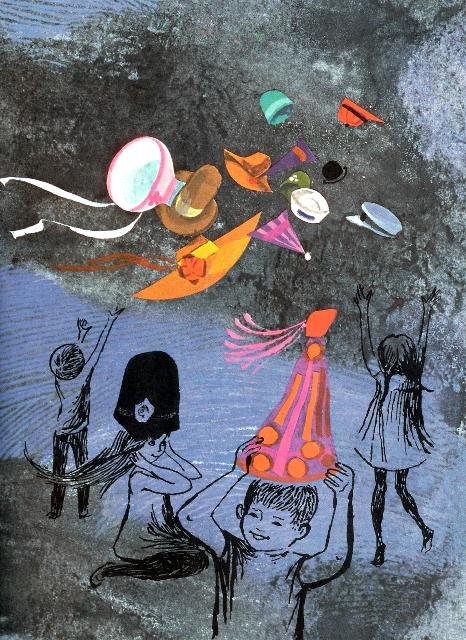 One of the things I look for when I'm hunting for books is a distinctive illustrative style. Many of the Parents Magazine Press books feature a bold, mimimal style that uses a lot of line drawings. Here, I want to show off some illustrations from books I just listed. First, Attic of the Wind by Doris Herold Lund and illustrated by Ati Forberg, is a stunning combination of cloudy background with brilliant foreground.
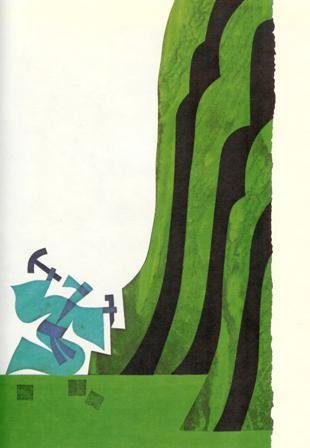 Next, The Stonecutter, though not a book I read as a child, seemed to fit perfectly among my collection, because of its bold, block-style prints.
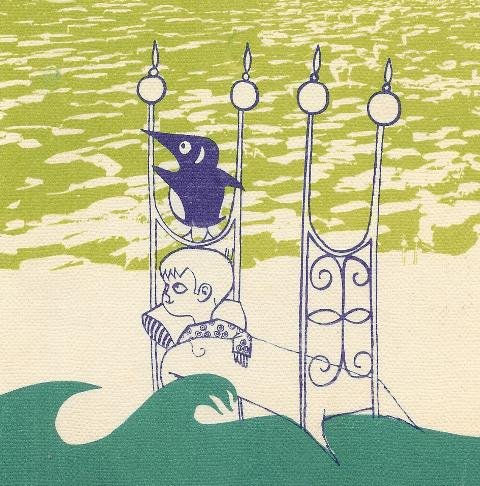 Finally, I found this very obscure book, The Bed that Went Whoosh to Moyle, neglected on the back shelves of a used book store. I knew I had to expose its quirky graphics to the world.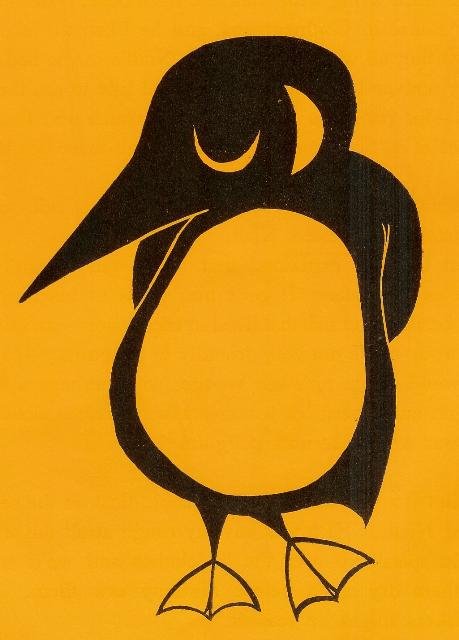
Upstairs, the penguin, was sad.
Wednesday, April 04, 2007
One Monster After Another by Mercer Mayer
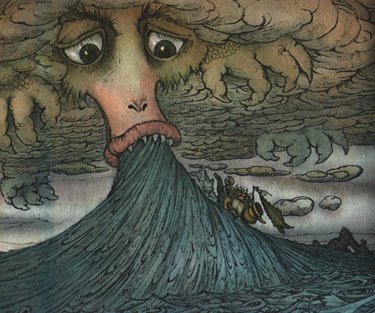
I bought a new copy of this book for Duncan before he was born. We read it today for the first time. I loved it just as much as I remembered, especially when the Wild Windy Typhoonigator sucks up the entire sea. If you have never read this book, time to try it with your own child!